
In a hidden corner of Yunnan, Shengguantun redefines luxury through raw textures, ancient tea rituals, and the quiet bea
The morning air in Shengguantun tastes faintly of pine smoke and damp slate. I am sitting on a low linen cushion at the courtyard edge, watching a thin curl of steam rise from a small clay dish of fresh *rubing*—the local goat cheese, lightly seared and drizzled with wild rose honey. Across the weathered pine table, a hand-beaten copper kettle hums softly over charcoal embers. The light here doesn't flood; it filters gently through the cracked lattice of century-old fir wood, casting long, quiet shadows across the hand-poured concrete floor.
When friends ask me about the top attractions in Shengguantun, I always pause. If you are looking for gilded monuments or grand, cordoned-off sights, this quiet corner of Yunnan will elude you. But if you understand that true luxury lies in restraint—in the patina of weathered clay, the whisper of mountain wind, and the space to simply breathe—then this village is a masterpiece of slow living.
Start your morning along the Old Cobble Way. It isn't a marked tourist path, just a narrow arterial vein woven from river stones, smoothed by generations of felt-soled shoes and mountain hooves. Walk slowly here. Pay attention to the surrounding walls. They are crafted from rammed earth and local limestone, held together by mud, straw, and time. Over decades, summer rain has carved subtle grooves into their surfaces, and soft green moss has claimed the shaded corners. It is wabi-sabi in its purest form: organic, imperfect, and deeply grounded in its landscape.
Tucked behind an understated bronze gate lies the Village Tea Cellar, an unpretentious sanctuary of Western minimalism infused with local craft. Here, a quiet tea master works with wild-harvested Pu’er from ancient trees higher up the ridge. The space is pared down to its bare essentials—raw plaster walls, a single slab of blackened oak for a table, and heavy, matte ceramic cups that warm your palms. I spent two hours here yesterday, listening to the drip of spring water into a stone basin, tasting a 2012 vintage that carried notes of wet cedar and dried plum.
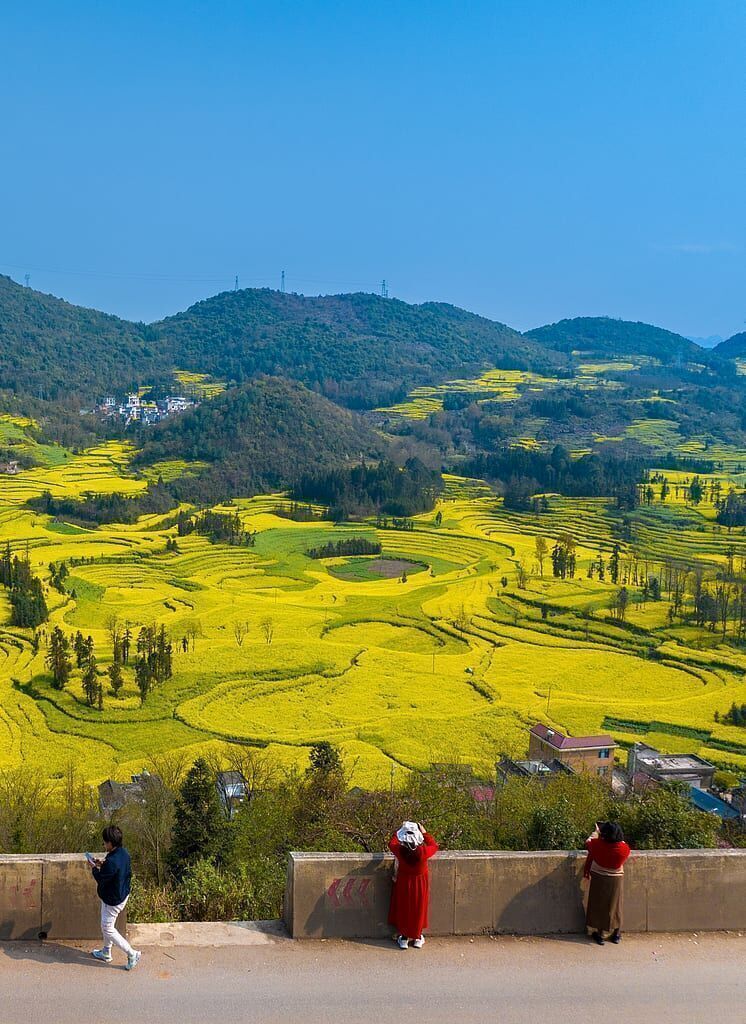
By late afternoon, make your way up to the North Ridge Overlook. The path winds past traditional Bai courtyard homes where garlands of chili peppers hang drying like coral beads against sun-bleached timber. As the light softens, step onto the elevated cedar deck overlooking the valley floor. The view opens into a serene tapestry: geometric patches of wild mustard fields, dark slate roofs catching the amber light, and the vast, glass-like sheen of the valley floor stretching toward distant blue peaks. There are no loudspeakers or crowd barriers here—only the dry rustle of pampas grass and the crisp alpine breeze.
As night falls, dinner is an understated ritual at one of the village’s micro-kitchens. Imagine wild matsutake mushrooms, hand-picked from the pine forests that morning, seared over open coals with coarse salt and paired with cured Yunnan ham sliced so paper-thin it turns translucent in the warm glow of paper lanterns.
In the quiet hours before sleep, when the village lanterns flicker into darkness, the silence in Shengguantun becomes almost tangible. You retreat to a room where unbleached linen meets smooth mortar walls, lulled by the faint sway of walnut branches outside your window. Shengguantun doesn't demand your attention with grandeur. Instead, it invites you to slow down until your pulse matches the natural rhythm of the land. That, to me, is the ultimate luxury.

读过之后,想来住几天吗?
朴归山居 · 云南升官屯 — 22°C 的东方侘寂旅居。
相关阅读
The Quiet Luxury of Yunnan: Where Wabi-sabi Meets Western Minimalism(云南旅居)
Beyond the crowds of Dali, a hidden valley in Yunnan unfolds
Yunnan's Hidden Glamping Paradise: Where Wabi-Sabi Meets Western Minimalism(云南旅居)
Among Yunnan's mist-wrapped mountains, a new breed of wilder
Wabi-Sabi and the Wired Life: A Digital Nomad's Yunnan(云南旅居)
In the mist-wrapped mountains of Yunnan, ancient Chinese imp